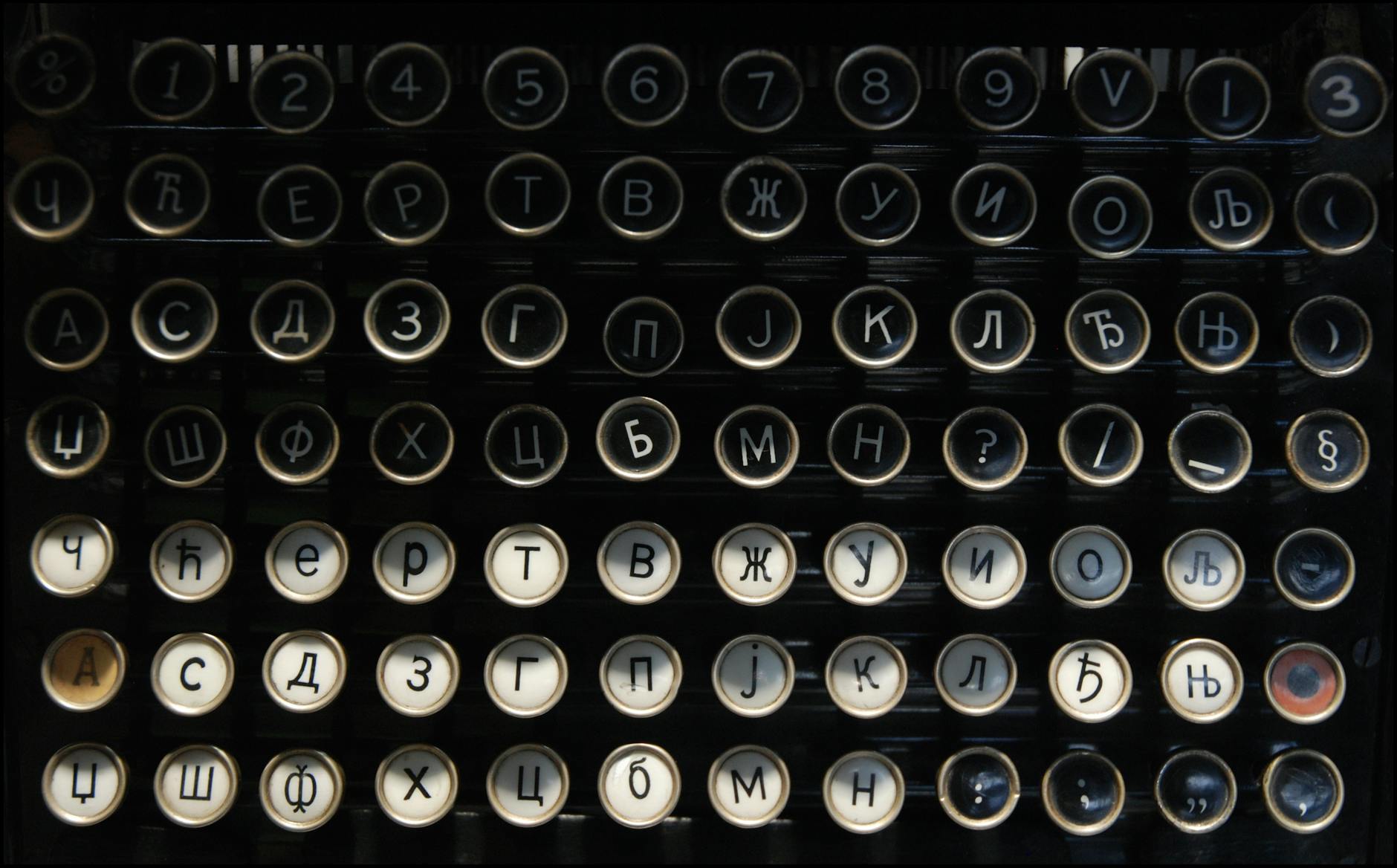
Of course! Here is a blog post detailing the history of the Cyrillic script and its deep connections to other writing systems.
Tracing the Roots of Cyrillic: A Script Born from an Empire’s Need
If you’ve ever looked at the curved and angular letters of the Russian alphabet and thought it looked impenetrable, you’re not alone. But what if I told you that this “mysterious” script shares a direct ancestor with the very letters you’re reading right now?
The Cyrillic alphabet, used by over 250 million people across Eastern Europe and Northern Asia, is not an isolated creation. It’s a brilliant piece of cultural and linguistic engineering, born at a crossroads of empires and faiths. Its story is a tale of two Byzantine brothers, a powerful Bulgarian tsar, and its deep, inseparable connection to one of the world’s most influential scripts: Greek.
The Stage is Set: A Empire’s Dilemma
In the 9th century, the Great Moravian Empire (in modern-day Czech Republic and Slovakia) found itself in a precarious position. Politically, it was caught between the expanding Frankish Kingdom to the west and the Bulgarian Empire to the east. Religiously, it was being pulled between the influence of Latin-speaking Roman Catholicism and Greek-speaking Eastern Orthodoxy.
Prince Rastislav of Great Moravia wanted a way to maintain his independence. He needed his own Christian liturgy, one in the Slavic language his people understood, rather than the foreign Latin or Greek. In 863, he appealed to the Byzantine Emperor Michael III for help. The emperor had the perfect men for the job: two brothers from Thessaloniki, Cyril and Methodius.
The First Draft: The Glagolitic Script
The brothers didn’t just translate the Bible; they first had to create a system to write the Old Church Slavonic language. The script they invented is known as Glagolitic (from the Old Church Slavonic glagolati, “to speak”).
Glagolitic was a masterpiece. It was a highly original and ornate script, with many letters seemingly created from scratch or inspired by contemporary cursive Greek and possibly even Georgian or Armenian. While it served its purpose, its complex characters were likely difficult to adopt widely.
The Evolution: From Glagolitic to Cyrillic
After the deaths of Cyril and Methodius, their disciples were expelled from Great Moravia and found a warm welcome in the Bulgarian Empire under the patronage of Tsar Boris I. It was here, in the 890s at the Preslav Literary School, that the real transformation happened.
Led by scholars like Clement of Ohrid, the disciples took the foundational work of their teachers and refined it. They created a new, more elegant and efficient script: the Cyrillic alphabet.
This new script wasn’t a replacement for Glagolitic so much as a brilliant simplification and reorganization. Its genius lay in its direct borrowing.
The Blueprint: The Greek Uncial Connection
To understand Cyrillic, you must first look at the Greek alphabet of the 9th century. The creators of Cyrillic took almost directly the 24 letters of the Greek uncial script—the formal writing used for religious texts—and used them for sounds that existed in both Greek and Slavic.
Take a look at these clear examples:
- А (A) comes from Greek Alpha (Αα)
- В (V) comes from Greek Beta (Ββ)
- Г (G) comes from Greek Gamma (Γγ)
- Д (D) comes from Greek Delta (Δδ)
- Е (E) comes from Greek Epsilon (Εε)
- К, Л, М, Н, О, П, Р, С, Т, Ф, Х… the list goes on. These are all direct adoptions from Greek.
But Old Church Slavonic had sounds that Greek did not. For these, the scholars had two solutions:
- Create New Letters: They designed new characters, often by modifying Greek letters or drawing from Glagolitic. For example:
- Ж (Zh, as in ‘pleasure’) – A unique creation.
- Ш (Sh, as in ‘ship’) and Щ (Sht, a softer ‘shch’) – Likely derived from Glagolitic or Hebrew Shin (שׁ).
- Ц (Ts, as in ‘its‘) – A modified form.
- Ч (Ch, as in ‘church’) – Another modification.
- Ъ (the “hard sign”) and Ь (the “soft sign”) – Crucial for representing Slavic palatalization, a feature absent in Greek.
- Use Glagolitic: Some letters, like Ш, are believed to have Glagolitic origins.
The Distant Cousins: Cyrillic and Latin
So, where does the Latin alphabet fit in? Both Cyrillic and Latin are descendants of the Greek alphabet, which itself evolved from the Phoenician script. This makes them distant cousins.
Because they share a common Greek ancestor, many Cyrillic letters look like Latin ones but represent different sounds. This is a classic source of “false friends” for learners:
- В looks like a Latin B, but it’s pronounced like a V.
- Н looks like a Latin N, but it’s pronounced like an N (okay, this one is the same!).
- Р looks like a Latin P, but it’s pronounced like an R.
- У looks like a Latin Y, but it’s pronounced like OO (as in ‘tool’).
- С looks like a Latin C, but it’s pronounced like an S.
Cyrillic’s Journey Through Time
From its birthplace in Bulgaria, Cyrillic spread like wildfire across the Slavic Orthodox world: to Kievan Rus’ (the predecessor of Russia, Ukraine, and Belarus), Serbia, and beyond. Over the centuries, it was adapted and reformed to fit local languages. The most significant reform was under Peter the Great in 1708, who introduced the “Civil Script,” a simplified version of Cyrillic that made it more suitable for secular publications and laid the groundwork for the modern Russian alphabet.
Later Soviet reforms removed some archaic letters, finalizing the 33-letter Russian alphabet we know today.
A Living Legacy
The story of Cyrillic is a powerful reminder that no script exists in a vacuum. It is a stunning hybrid, a testament to the intellectual prowess of its creators who built a lasting cultural monument on a Greek foundation.
The next time you see Cyrillic text, remember—you’re not just looking at a “Russian alphabet.” You’re looking at a piece of 9th-century diplomatic genius, a direct descendant of Greek, and a cousin to the Latin letters on this page. It’s a script that carries the weight of empires, the passion of saints, and the enduring voice of the Slavic peoples.
Leave a Reply
You must be logged in to post a comment.