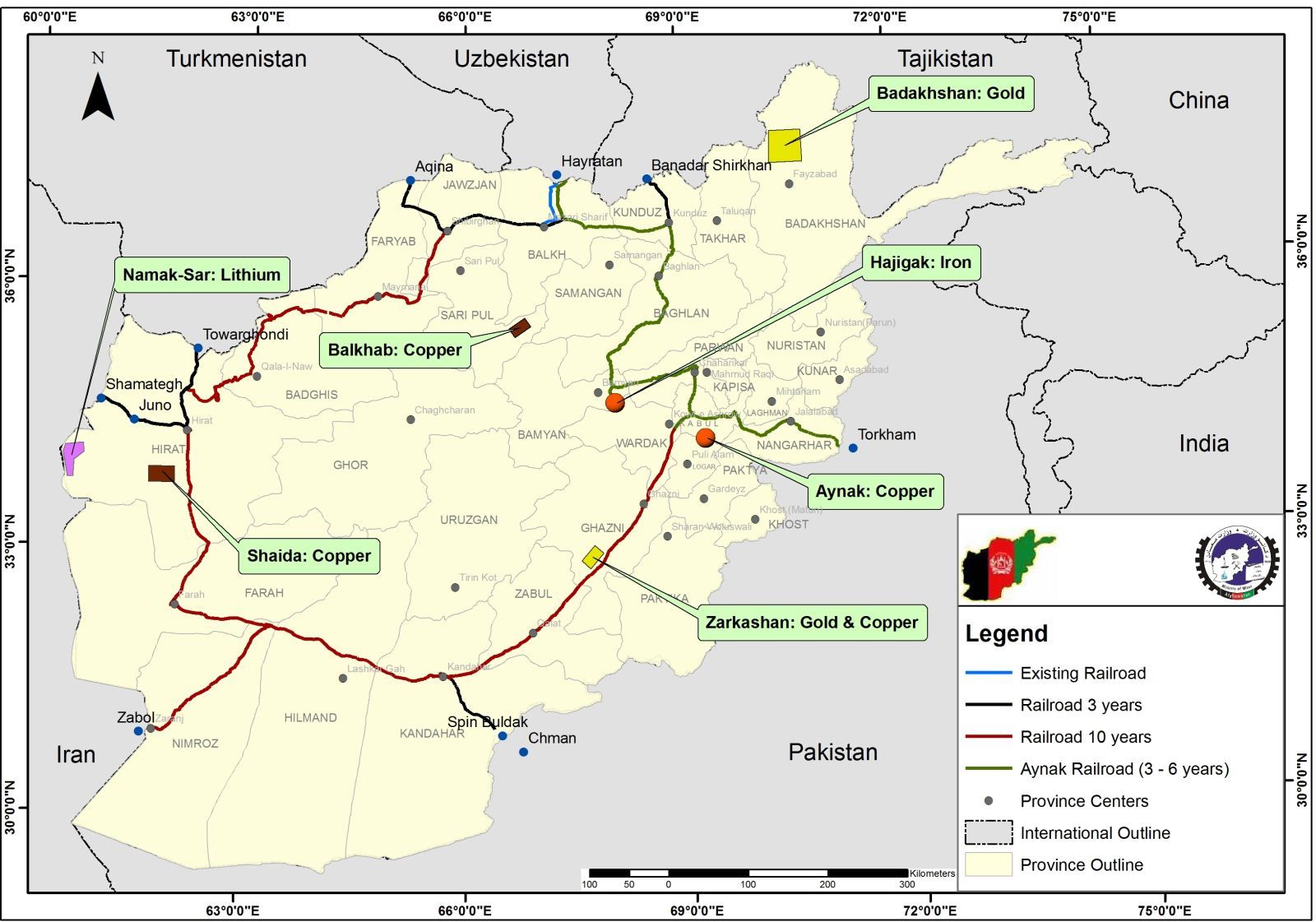
The development of new railway lines in Afghanistan represents a transformative effort to position the country as a central transit hub connecting Central and South Asia. Here’s a summary of key projects and their significance:
🚆 1. Trans-Afghan Railway (Uzbekistan-Afghanistan-Pakistan Corridor)
- Route: Termez (Uzbekistan) – Mazar-i-Sharif – Kabul – Peshawar (Pakistan), with extensions to Pakistani ports (Karachi and Gwadar) .
- Length: Approximately 774 km (with a 681 km section in Afghanistan) .
- Cost: Estimated $4.6–$7 billion .
- Features: Includes 336 bridges, 5 tunnels, and connections to logistics hubs. Aims to reduce transit time from 35 days to 4 days and increase cargo capacity to 20 million tons annually by 2040 .
- Progress: A trilateral framework agreement for feasibility studies was signed in July 2025. Construction is expected to take 5 years .
- Strategic Importance: Provides landlocked Central Asian countries access to Pakistani seaports, integrates with Russia’s International North-South Transport Corridor (INSTC), and supports Afghanistan’s economic recovery .
🚆 2. Towrgondi–Herat–Kandahar–Spin Boldak Railway (Backed by Kazakhstan)
- Route: Connects Towrgondi (Turkmen border) to Herat, Kandahar, and Spin Boldak (Pakistan border) .
- Length: 790 km .
- Cost: Kazakhstan pledged $500 million for the first phase (Towrgondi–Herat) .
- Features: Part of the Central Asia–South Asia (CASA) corridor. Includes a fiber-optic cable for digital infrastructure .
- Progress: MoU signed between Afghanistan and Kazakhstan in 2025. Phase 1 (Towrgondi–Herat) includes a logistics hub in Herat .
- Strategic Importance: Offers Kazakhstan and Turkmenistan direct access to Indian Ocean ports and integrates with Iran’s rail network via Herat .
🚆 3. Khaf–Herat Railway (Afghanistan-Iran Link)
- Route: Khaf (Iran) to Herat (Afghanistan) .
- Length: 225 km (140 km in Afghanistan, 85 km in Iran) .
- Features: Standard gauge, facilitating cargo and passenger services. Connects to Iran’s rail network, enabling access to Turkish and European markets .
- Progress: Operational since 2023 for cargo trials. Passenger services to Mashhad (Iran) are planned .
- Strategic Importance: Integrates Afghanistan with Iranian ports (Chabahar) and supports the Iran–Afghanistan–Tajikistan–Kyrgyzstan–China corridor (“Five Nation Road”) .
🚆 4. Mazar-i-Sharif–Herat Railway
- Route: Connects Mazar-i-Sharif (northern Afghanistan) to Herat (western Afghanistan) .
- Features: A strategic segment of the Iran–China corridor, potentially extending to the Wakhan Valley (China border) .
- Progress: Agreed upon by Uzbekistan and Afghanistan in February 2025. Part of broader efforts to link Uzbekistan with Iran and China .
- Strategic Importance: Reduces dependency on northern routes through Russia and enhances trade between Uzbekistan, Iran, and China .
🚆 5. Other Regional Connections
- Turkmenistan-Afghanistan Lines: Upgrades to the Torghundi–Herat line and construction of the Andkhoy–Sheberghan line as part of the TAT (Turkmenistan–Afghanistan–Tajikistan) project .
- Pakistan-Afghanistan Links: Proposed lines from Chaman to Spin Boldak and Peshawar to Jalalabad (though currently paused) .
- Tajikistan-Afghanistan Link: Planned extension from Tajikistan to Sher Khan Bandar (Afghanistan) .
💡 Challenges and Opportunities
- Security: The Taliban government has provided security guarantees, but risks persist in Afghanistan and Pakistan .
- Funding: Relies on international partnerships (e.g., Russia, Kazakhstan) and institutions .
- Gauge Differences: Afghanistan uses standard gauge (1,435 mm) to balance between neighboring broad gauge (Pakistan) and Russian gauge (Central Asia) .
- Economic Impact: Projects aim to generate jobs, boost trade, and integrate Afghanistan into regional supply chains .
💎 Overall Significance
These railways aim to transform Afghanistan from landlocked to a “land-linked” hub, reducing transit costs and times for regional trade. They reflect growing cooperation between Central Asian states, Pakistan, Iran, and Russia, with potential to reshape Eurasian logistics .
For further details, you can explore the sources cited above.
Of course. Here is a map illustrating the major new and planned railway lines in Afghanistan and its connections to neighboring countries.
Map of Key Afghan Railway Projects
This map highlights the primary corridors under development or consideration.
flowchart TD
    subgraph Neighboring Countries
        UZB[Uzbekistan<br>Termez]
        TKM[Turkmenistan]
        TAJ[Tajikistan]
        IRN[Iran]
        PAK[Pakistan]
        CHN[China]
    end

    subgraph A [Afghanistan Railway Corridors]
        MAZ[Mazar-i-Sharif]
        KBL[Kabul]
        HER[Herat]
        KAN[Kandahar]
        SPB[Spin Boldak]
    end

    %% Trans-Afghan Corridor (North-South)
    UZB -- Existing & Planned<br>Mazar-i-Sharif to Kabul --> MAZ
    MAZ -- Trans-Afghan Railway<br>Planned --> KBL
    KBL -- Trans-Afghan Railway<br>Planned --> PAK

    %% Western Corridor (East-West)
    TKM -- Towrgondi-Herat Railway<br>Phase 1 Planned --> HER
    TAJ -- Potential Future Link --> HER
    HER -- Mazar-i-Sharif-Herat Railway<br>Planned --> MAZ
    HER -- Khaf-Herat Railway<br>OPERATIONAL --> IRN

    %% Southern Corridor
    HER -- Towrgondi-Kandahar Railway<br>Planned --> KAN
    KAN -- Planned --> SPB
    SPB -- Connection to Pakistan Network --> PAK

    %% Northern Link
    MAZ -- Connection to Uzbekistan Network --> UZB

    %% Eastern China Connection (Conceptual)
    HER -- Long-term concept to link<br>via Wakhan Corridor --> CHN
Corridor Details & Status
| Railway Corridor | Key Route | Status & Significance |
|---|---|---|
| 🧭 Trans-Afghan Railway | Termez (UZB) – Mazar-i-Sharif – Kabul – Peshawar (PAK) | Planned. The most strategic project. Aims to provide Central Asia direct access to Pakistani seaports. Framework agreement signed in 2025. |
| 🧭 Towrgondi–Herat–Kandahar | Towrgondi (TKM) – Herat – Kandahar – Spin Boldak (PAK) | Planned (Phase 1). Backed by Kazakhstan. Part of the Central Asia–South Asia (CASA) corridor to access Indian Ocean ports. |
| ✅ Khaf–Herat Railway | Khaf (IRN) – Herat (AFG) | Operational (since 2020). Afghanistan’s first international rail link. Connects to Iranian seaports like Chabahar. |
| 🧭 Mazar-i-Sharif–Herat | Mazar-i-Sharif – Herat | Planned. A critical east-west link inside Afghanistan to connect Uzbekistan’s network to Iran. |
| 🔧 Other Connections | Various links from Turkmenistan and Tajikistan. | Planned/Upgrading. Smaller projects to increase regional connectivity and trade capacity. |
Key Challenges:
- Funding: These are multi-billion dollar projects requiring significant international investment.
- Security: While the current government provides security guarantees, long-term stability is a concern for investors.
- Technical Standards: Balancing different rail gauges used by neighbors (e.g., Russian gauge in the north vs. standard gauge in Iran and Pakistan) is a complex issue.
This network is designed to transform Afghanistan from a land-locked country into a central land-linked transit hub for trade between Central Asia, South Asia, and the Middle East.
Leave a Reply
You must be logged in to post a comment.