Published: January 25, 2026
For millennia, acupuncture has been a cornerstone of Traditional Chinese Medicine (TCM), yet Western medicine has frequently dismissed it as placebo due to a perceived lack of clear biological mechanisms. A recent discussion sparked by neurosurgeon and quantum biology advocate Dr. Jack Kruse points to emerging research suggesting acupuncture—especially electroacupuncture—may operate through very concrete, traceable pathways involving stem cell mobilization, endogenous electric currents, and even light-based signaling in cells.
The Core Claim from Recent Research
Researchers at China Medical University in Taiwan (published in Stem Cells Translational Medicine, 2025) investigated electroacupuncture (acupuncture needles connected to a mild electrical current) applied at two classic points:
- ST36 (Zusanli, on the lower leg)
- GV20 (Baihui, at the crown of the head)
They reported a dramatic ~300% increase in circulating mesenchymal stem cells (MSCs) detectable in the bloodstream within 24 hours of treatment. These MSCs—multipotent adult stem cells typically residing in bone marrow—appear to be mobilized into circulation, then home in on damaged tissues (brain, heart, liver, kidneys, etc.), where they can differentiate into organ-specific cells and secrete paracrine healing factors (cytokines, growth factors, exosomes).
Kruse emphasizes that this is not placebo: the effect is measurable via cellular tracking, imaging, and biomarkers. He links it to earlier work showing similar mobilization (~313% increase in a 2017 STEM CELLS study using electroacupuncture).
Clinical examples cited include:
- Stroke patients treated within 48 hours showing ~40% better functional recovery versus standard care.
- Reduced fibrosis markers in liver cirrhosis.
- Improved cardiac function post-myocardial infarction.
The mechanism is framed as the body’s endogenous “repair dispatch system” being activated by precise peripheral stimulation.
Connecting the Dots: Robert O. Becker’s DC Currents
Kruse repeatedly references the late orthopedic surgeon and bioelectromagnetics pioneer Robert O. Becker (author of The Body Electric). In the 1970s–1980s, Becker demonstrated that living tissues maintain direct current (DC) electrical potentials and gradients, and that these semi-conducting currents guide regeneration (e.g., in salamander limb regrowth, fracture healing in mammals).
Becker explicitly linked acupuncture points and meridians to these DC electrical pathways. He found that acupuncture points often show lower electrical resistance and that needle insertion perturbs local DC fields in ways consistent with regenerative signaling. Kruse argues the Taiwanese findings align with Becker’s model: needle + mild current → perturbation of endogenous DC gradients → stem cell release from marrow → targeted repair.
Quantum Biology Angle: Ultraweak Photon Emission (UPE) & Photorepair
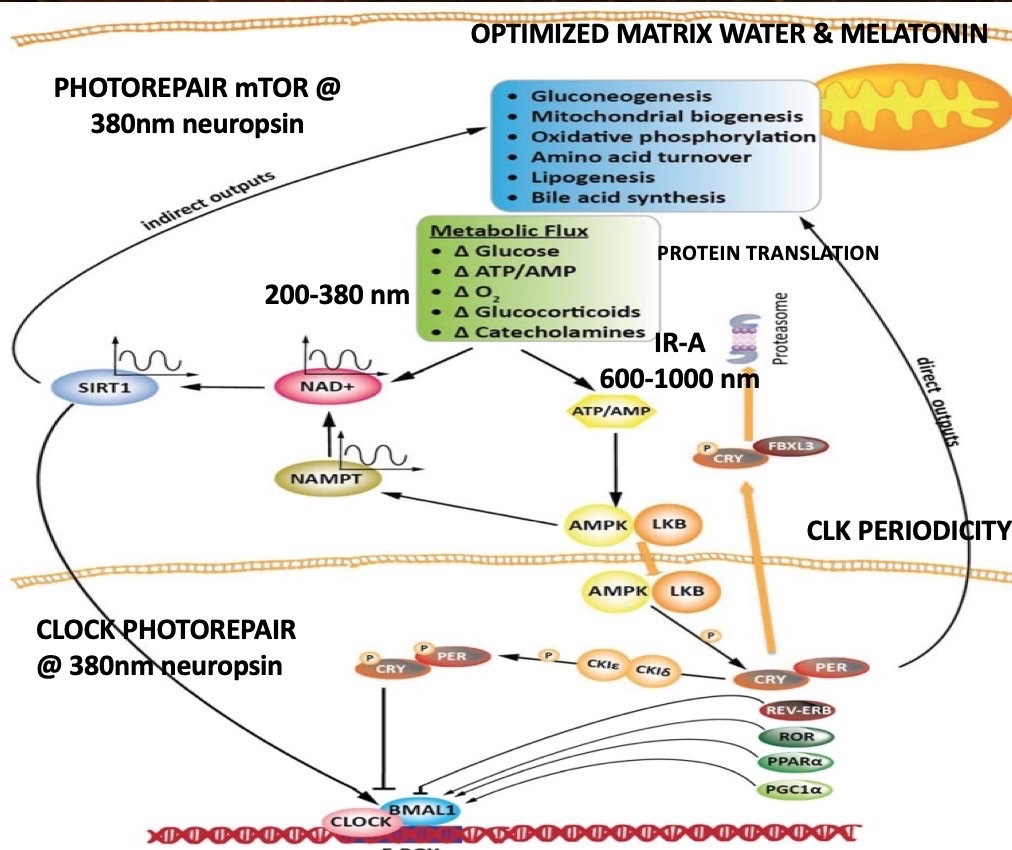
Kruse adds a modern twist from quantum biology. He proposes that needle trauma stimulates ultra-weak photon emission (UPE / biophotons) from cells at the acupuncture site. These photons (especially around 380 nm wavelength) may activate photoreceptive proteins such as neuropsin (OPN5) in mammalian tissues.
This light signal could then influence downstream metabolic pathways involving:
- SIRT1 (a longevity/sirtuin protein)
- NAD+ recycling
- Circadian clock genes
- Redox balance
Attached diagrams in his thread illustrate hypothesized light-driven fluxes connecting acupuncture stimulation → UPE → photorepair → mitochondrial enhancement → stem cell behavior. While this layer remains more speculative/hypothetical than the stem cell mobilization data, it reflects growing interest in non-chemical signaling (light, electric fields, magnetic moments) in regenerative medicine.
Caveats and Where the Evidence Stands
- The 2025 China Medical University paper is recent; full methods, exact effect sizes, controls, and independent replications are still filtering into the broader literature.
- Earlier related studies (e.g., 2017 STEM CELLS on ~313% MSC increase, various PubMed entries on EA at ST36 modulating stem cells in autoimmune models) provide supporting precedent.
- Becker’s DC work, while groundbreaking, was controversial in its era and remains under-discussed in mainstream orthopedics/neurosurgery.
- The UPE/photorepair link is an active frontier in quantum biology but lacks the same level of direct experimental confirmation in acupuncture contexts as the stem cell findings.
Bottom Line
If the Taiwanese data and related studies hold up under further scrutiny, electroacupuncture at key points could represent a low-cost, non-pharmacological method to systemically boost regenerative capacity via endogenous stem cell deployment. Combined with Becker’s bioelectric framework and emerging quantum biology ideas, it offers a bridge between ancient meridian theory and 21st-century mechanistic medicine.
For clinicians and researchers: consider exploring electroacupuncture protocols in regenerative contexts (post-stroke, cardiac recovery, chronic organ damage). For skeptics: the placebo critique is being directly challenged by traceable cellular kinetics—not belief, but biology.
Further reading (from Kruse’s links and related sources):
- Search PubMed for “electroacupuncture mesenchymal stem cells ST36”
- Becker’s classic papers on DC currents and acupuncture points
- Reviews on UPE and photorepair proteins in mammals
What was once dismissed as mysticism may increasingly look like underappreciated physiology. The conversation is evolving—fast.
(Disclosure: This post synthesizes publicly available claims and referenced studies; always consult primary sources and qualified practitioners for medical decisions.)
Leave a Reply
You must be logged in to post a comment.